May 22, 2025 · 4 min read
Mount Rainier, Washington
By the Credence Charter Bus team
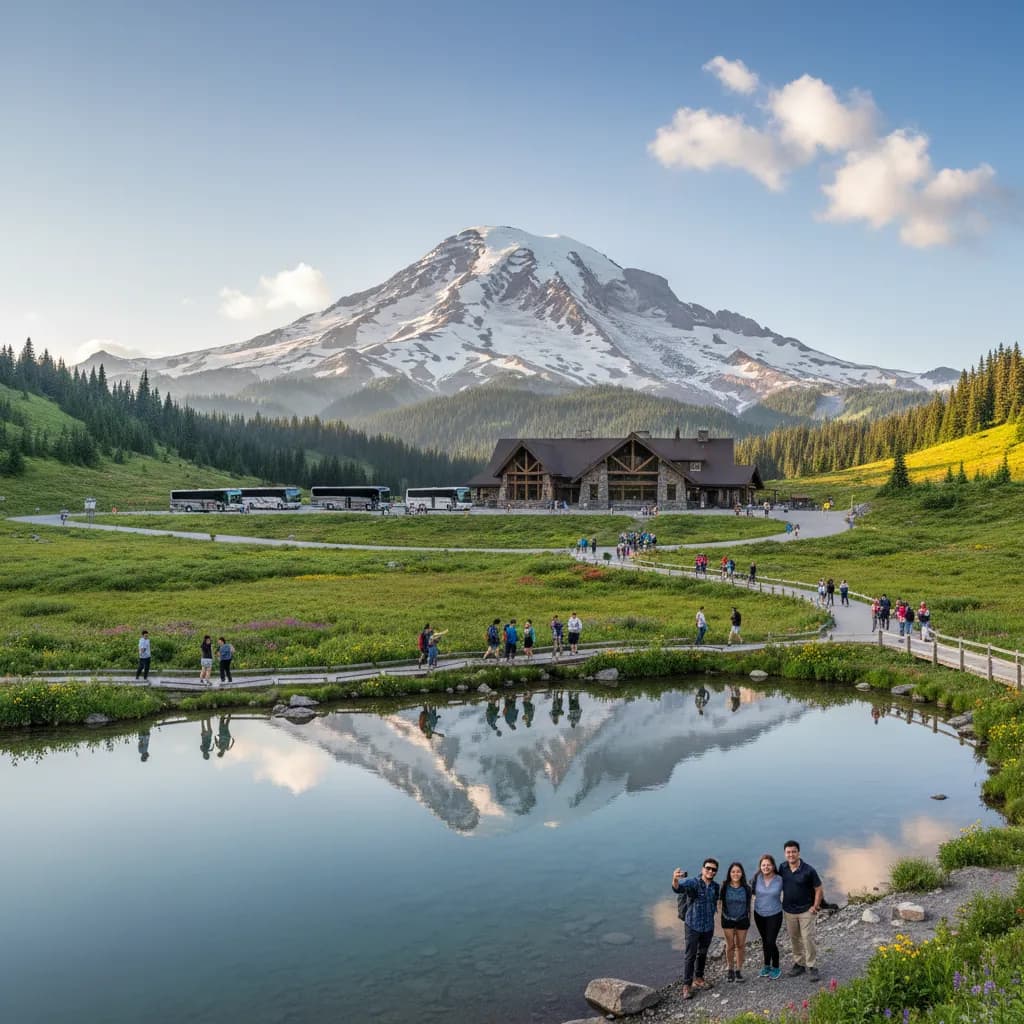
Mount Rainier is 14,410 feet of active volcano carrying more glacial ice than any other peak in the lower 48, and on a clear day it dominates the horizon from a hundred miles away. It is also a park where the roads, not the trails, decide what a group can do. A charter bus to Mount Rainier works well once the entrance and the vehicle are matched to the itinerary.
Check the reservation system before anything else
The park has operated timed-entry reservations for the Paradise and Sunrise corridors during peak summer months in recent years. The details have changed season to season, so confirm the current requirement when you set the date rather than assuming last year's rules apply.
This matters more for a group than for a car. A vehicle turned away at the Nisqually entrance with fifty people aboard has nowhere useful to go, and the alternative entrances are an hour or more away by road.
Paradise or Sunrise
Paradise, at 5,400 feet on the south side, is where most groups go. It has the Henry M. Jackson Visitor Center, the wildflower meadows, waterfalls, and paved trails that work for a wide range of walking abilities. It is reached through the Nisqually entrance near Ashford, which is the only one open year-round.
Sunrise, at 6,400 feet on the northeast side, is the highest point reachable by road in the park and arguably the better view. The access road is a series of tight switchbacks with length restrictions, it opens only from roughly July to September, and it is not a road for a full-size coach without checking first.
For most groups the answer is Paradise. For a smaller group in a smaller vehicle, Sunrise on a clear day is the more memorable half of the mountain.
Which charter bus suits the park
- Forty to fifty-six: a full-size charter bus is comfortable on the Nisqually–Paradise road and for the approach from Seattle or Tacoma. Confirm any length restrictions on Stevens Canyon and Sunrise before including them.
- Twenty to thirty-two: a mini bus is the flexible choice, able to reach Sunrise and the tighter pull-offs while still carrying a real group.
- Ten to fourteen: a sprinter van goes everywhere in the park and suits a photography group working the light on the mountain.
The entrance fee is charged per vehicle, so a coach is dramatically cheaper than a convoy of cars — one fee rather than a dozen.
The wildflowers, and when they actually happen
Paradise gets an extraordinary snowpack — one of the highest annual totals ever recorded anywhere was measured here — and it lingers. Meadows that look like alpine lawn in a photograph are frequently under several feet of snow into early July.
Peak bloom is usually late July into early August, and it is worth timing a group trip to it. A visit in mid-June to see wildflowers will find snow instead, which is beautiful and not what anyone was promised.
The mountain is often invisible
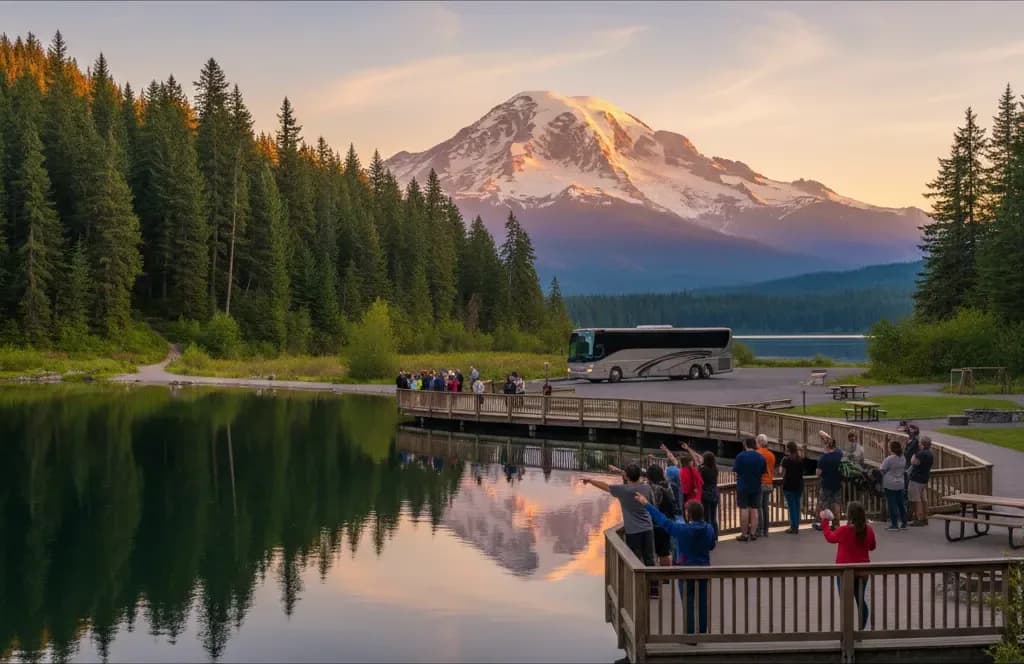
This is worth saying plainly to a group before departure. Rainier makes its own weather and is hidden in cloud for a large share of the year. July through September gives the best odds by a wide margin; outside that window a clear view is genuinely a matter of luck.
The park is still worth the trip on a gray day — the old-growth forest, the waterfalls and the rivers are unaffected — but managing the expectation beforehand is the difference between a good day and a disappointed one.
What a group can actually walk
Paradise is unusually good for mixed-ability groups. The Skyline Trail loop is a genuine five-mile climb with 1,700 feet of gain, but the lower paved sections of the same network give big meadow views within twenty minutes of the visitor center, and Myrtle Falls is about half a mile on pavement.
Lower down, the Grove of the Patriarchs near the Stevens Canyon entrance is a flat forest walk among thousand-year-old cedars and Douglas firs — check current access, as the river bridge there has been closed at times. Christine Falls and Narada Falls are both roadside stops requiring almost no walking at all.
The altitude is worth mentioning to a group. Paradise sits at 5,400 feet, and visitors arriving from sea level frequently find the short climbs harder than they expect.
Getting there
The Nisqually entrance is about two and a half hours from Seattle, roughly ninety minutes from Tacoma, and around two hours from Olympia. We also run pickups from Puyallup and Yakima for groups approaching from the east.
Groups searching for charter bus rental near me for a Rainier day should be realistic: from Seattle it is five hours of driving for four or five hours in the park. It works, and an overnight in Ashford or Packwood works considerably better.
Booking the trip
Send your date, headcount, and whether Sunrise is on the list — that single answer determines the vehicle. Our event transportation team plans park itineraries around road openings and daylight.
Request an all-in quote and you will usually have an itemized price back the same day, driver, fuel, tolls and taxes included.