
May 10, 2026 · 4 min read
Pacific Coast Highway, California
By the Credence Charter Bus team
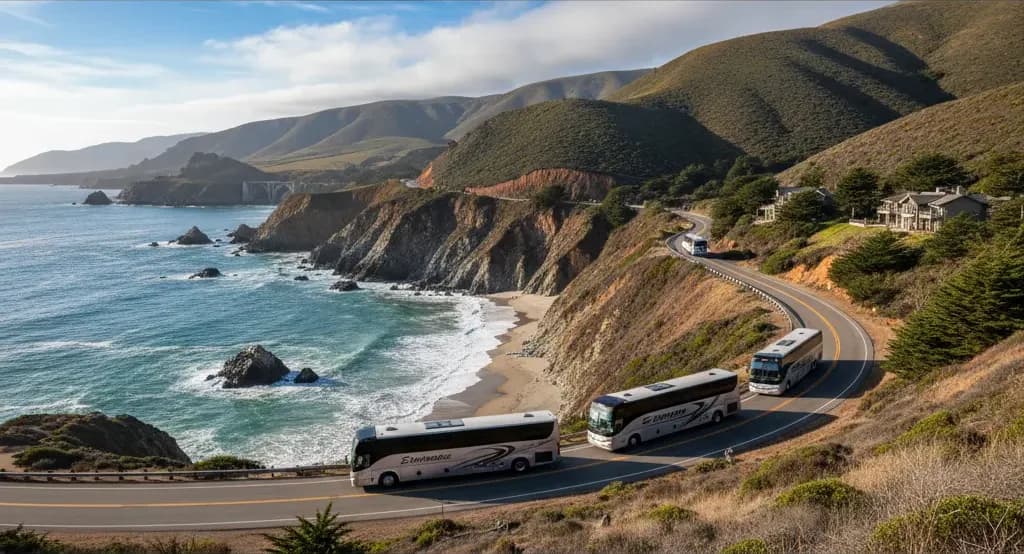
A ribbon of asphalt along the edge of a continent, cliffs dropping into the Pacific, and coastal towns strung out along the way — the Pacific Coast Highway earns its reputation. It also punishes anyone who tries to do it in a convoy of cars. A charter bus to the Pacific Coast Highway turns the hardest part of the trip, which is the driving, into the part nobody has to think about.
Here is the honest version of what the route involves, which stops work for a group, and what a coach can and cannot do on Highway 1.
Why the PCH suits a group and punishes a car convoy
The full route from Dana Point to Leggett runs roughly 650 miles, and the celebrated section between Monterey and San Simeon is a two-lane road with limited pullouts and no fast way around anything. In separate cars a group loses each other within the first hour, then spends the day texting about where to regroup. On one vehicle the group arrives at each overlook together, and the driver is the only person who has to watch the road instead of the view.
The other advantage is that the passengers get the scenery. On Highway 1 the driver sees a guardrail and a series of blind curves; everybody else sees the coastline. That is a genuinely different trip depending on which seat you are in.
The stops worth building the itinerary around
These handle groups well and have somewhere for a large vehicle to stop:
- Santa Monica Pier: the southern bookend, with the Ferris wheel and a straightforward drop-off on Ocean Avenue.
- Santa Barbara: Spanish Colonial architecture and State Street, and the best lunch stop on the southern half of the route.
- Solvang: a Danish-founded village inland of the coast that absorbs a coach group easily and makes a good mid-morning break.
- Big Sur: Bixby Creek Bridge, McWay Falls at Julia Pfeiffer Burns State Park, and the redwoods at Pfeiffer Big Sur. The scenic heart of the drive and the tightest for parking.
- Carmel-by-the-Sea and Monterey: Cannery Row, the Monterey Bay Aquarium, and the easiest coach parking on the central coast.
Which charter bus fits a Pacific Coast Highway trip
Vehicle choice matters more here than on an interstate run, because the road itself sets limits. Match the size to the group, then check it against the stops you actually want.
- Forty or more: a full-size charter bus seats 40 to 56 with reclining seats, climate control, an on-board restroom and deep luggage bays. On a multi-day coastal run the restroom is the detail that matters most, because the gaps between facilities are long.
- Twenty to thirty-two: a mini bus reaches pullouts and park lots a 45-foot coach has to skip, and it turns around in places a coach cannot.
- Ten to fourteen: a sprinter van goes essentially anywhere a car goes, which on this particular road is worth real money.
If your group is near the boundary between two sizes, ask for both prices. On the PCH the smaller vehicle sometimes wins on access even when the larger one wins on cost per seat.
Where a coach can and cannot go
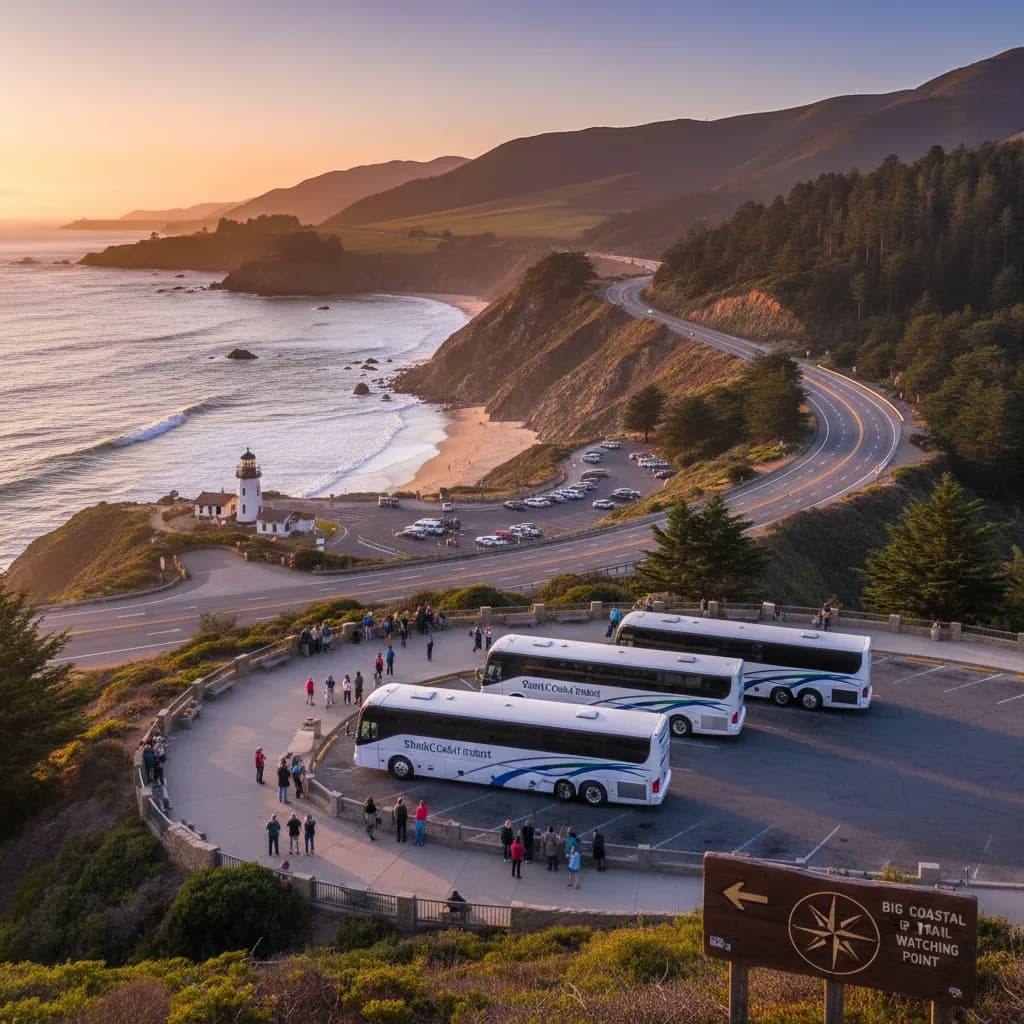
Most major stops along the route are equipped for buses, with marked coach parking or a drop-off lane. The exceptions are concentrated in Big Sur, where several of the famous pullouts are small gravel shoulders that a full-size coach should not attempt. A driver who already knows which ones work is worth more than any amenity on the vehicle, and it is the main reason groups searching for charter bus rental near me from out of state should ask about route experience rather than fleet age.
Highway 1 also closes. Landslides have shut the Big Sur section for months at a time in recent years, and the detour is not a short one. Check Caltrans before you finalize the itinerary and again in the week before you travel, and build the trip so a closure means reordering the plan rather than canceling it. We serve pickups from San Francisco, Monterey, Santa Barbara and Los Angeles, which covers both ends of the route and the middle.
How many days to allow
The drive can be done in about ten hours if you never stop, which is a way of seeing the road rather than the coast. Two to three days is the realistic minimum for a group that wants to get off the bus. A common shape is Los Angeles to Santa Barbara on day one, Santa Barbara to Monterey through Big Sur on day two, and Monterey to San Francisco on day three, which keeps each driving day under five hours and leaves the afternoons free.
When to go
- April to May and September to October: mild weather, clearer skies, and lighter traffic than midsummer. The best window for a group.
- June to August: warmest and busiest, and the coast often sits under morning fog that burns off late. Book vehicles early.
- November to March: quiet and frequently beautiful, but this is when slides close the road. Keep the itinerary flexible.
Booking the trip
Send the dates, the headcount and every stop you are considering, including the ones you are unsure about — pricing the whole shape of a trip up front is much easier than adding a day later. Our event transportation team plans multi-day coastal itineraries around driving hours rather than mileage, which is the number that actually governs this route.
Request an all-in quote and you will usually have an itemized price back the same day, with driver, fuel, tolls and taxes included.